
Old Wives Tales Gender Quiz: Boy or Girl Pregnancy Test
What Is the Old Wives Tales Gender Quiz?
The old wives tales gender quiz is a fun pregnancy quiz based on traditional myths used to guess whether a baby might be a boy or a girl.
For generations, people have used pregnancy symptoms such as food cravings, morning sickness, baby heart rate, and belly shape to predict baby gender.
While these pregnancy myths are not scientifically proven, many expecting parents enjoy taking a boy or girl quiz just for fun while waiting for their ultrasound scan. Many parents search for old wives tales boy or girl predictions online to see what traditional pregnancy myths suggest.
🔍 Popular Gender Prediction Tools
Take the Boy or Girl Pregnancy Quiz
Answer the following questions based on common pregnancy myths to get your pregnancy gender quiz result.
1. Are you craving sweet foods or salty foods?
Quiz Results: Boy or Girl?
If most of your answers match the girl predictions, the quiz suggests you might be having a girl. If most answers match the boy predictions, the quiz suggests you might be having a boy.
Remember that this old wives tales pregnancy quiz is only for entertainment and not medically accurate. The quiz results are based on common pregnancy myths with no scientific backing.
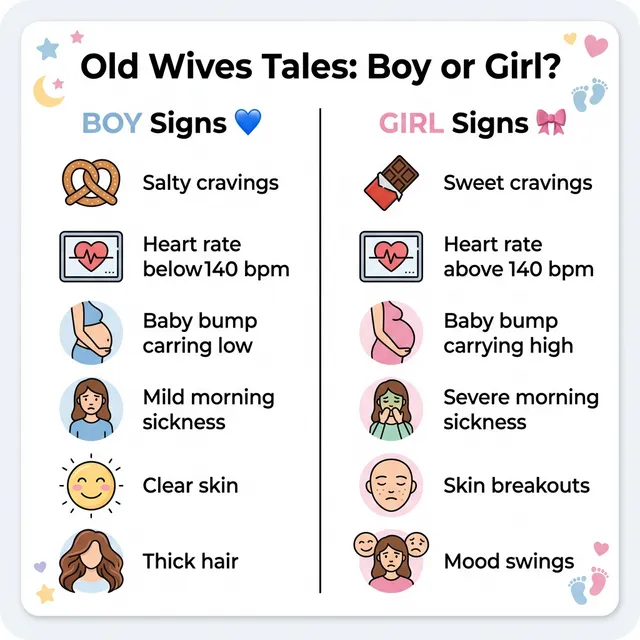
| Symptom | 💙 Boy Sign | 🎀 Girl Sign |
|---|---|---|
| Food Cravings | Salty, savory | Sweet, chocolate |
| Heart Rate | Below 140 BPM | Above 140 BPM |
| Morning Sickness | Mild | Severe |
| Belly Shape | Low, pointed | High, round |
| Skin Changes | Clear skin | More breakouts |
| Hair Growth | Thicker, faster | No change |
| Mood | Calm, stable | Mood swings |
| Energy | More energetic | More tired |
Most Popular Pregnancy Gender Myths
These are the most common old wives tales used in pregnancy gender quizzes around the world:
- Food cravings myth: Craving sweet foods means girl, salty foods means boy (try our pregnancy cravings gender predictor)
- Baby heart rate prediction: Above 140 BPM indicates girl, below indicates boy
- Belly shape myth: Carrying high means girl, carrying low means boy
- Morning sickness gender myth: Severe morning sickness indicates a girl
- Skin changes during pregnancy: Breakouts and dull skin suggest a girl
- Hair growth myth: Faster leg hair growth indicates a boy
- Ring test: Dangling a ring over the belly — circles mean girl, swings mean boy
- Chinese Gender Chart: Uses mother's lunar age and conception month (try it here)
None of these pregnancy myths have been scientifically proven. They remain popular because they are fun and easy to try at home during pregnancy.
Are Old Wives Tales Accurate for Predicting Baby Gender?
No. The old wives tales gender quiz is not scientifically accurate. All pregnancy gender myths have approximately 50% accuracy — the same as flipping a coin.
The only reliable methods for determining baby gender are medical tests:
| Method | Earliest Use | Accuracy | Type |
|---|---|---|---|
| Old Wives Tales | Any time | ~50% | Myth |
| Nub Theory | 11–14 weeks | 70–80% | Ultrasound |
| Ultrasound Scan | 18–20 weeks | 95–99% | Medical |
| NIPT Blood Test | 10 weeks | 99% | Medical |
Other Baby Gender Prediction Tools
If you enjoyed taking this boy or girl pregnancy quiz, explore these other prediction tools:
- Nub Theory Predictor — Ultrasound-based method (70–80% accuracy)
- Ramzi Theory Predictor — Placenta placement method
- Skull Theory Predictor — Skull shape analysis
- Baking Soda Gender Test — At-home urine test myth
- Chinese Gender Chart — Ancient lunar calendar method
- Pregnancy Cravings Predictor — Food cravings gender myth
Why Old Wives Tales Became Popular in Pregnancy
Old wives tales about pregnancy gender have been shared for hundreds of years in many cultures. Before modern medical technology, families often relied on traditional signs to guess whether a baby might be a boy or a girl.
Although modern medicine now provides accurate gender testing through ultrasound and genetic screening, pregnancy myths such as food cravings, heart rate predictions, and belly shape remain popular because they are fun to try.
Many parents enjoy taking an old wives tale gender prediction quiz before their ultrasound appointment as a fun way to bond with family and friends during pregnancy.
Complete List of Old Wives Tales for Gender
Here is a full list of the most popular old wives tales used for pregnancy gender prediction:
- Sweet cravings vs salty cravings
- Baby heart rate above or below 140 BPM
- Carrying high vs carrying low
- Morning sickness severity
- Skin breakouts during pregnancy
- Hair growth speed
- Ring test gender prediction
- Chinese gender chart
- Mood swings and emotional changes
- Linea nigra position on belly
- Weight gain distribution
- Cold feet during pregnancy
- Garlic test (body odor after eating garlic)
- Baby bump shape (round vs pointed)
- Dreaming about baby gender
None of these myths have been scientifically proven. For accurate results, always consult your healthcare provider.
Frequently Asked Questions
Do old wives tales really predict baby gender? ▶
No scientific evidence supports pregnancy gender myths. These quizzes are meant for entertainment only and have approximately 50% accuracy, the same as random chance. For accurate gender prediction, use medical tests like NIPT or ultrasound.
What is the most accurate way to know baby gender? ▶
The most accurate methods are NIPT blood tests (99% accuracy from 10 weeks) and ultrasound anatomy scans (95–99% accuracy at 18–20 weeks). For a fun early prediction method with some scientific backing, try the Nub Theory predictor which has 70–80% accuracy.
Are pregnancy quizzes accurate? ▶
Most pregnancy quizzes have around 50% accuracy because they are based on traditional myths and old wives tales. No pregnancy symptom can reliably predict baby gender. These quizzes are popular because they are fun and easy to take during pregnancy.
What are the most common old wives tales for gender? ▶
The most popular old wives tales include: food cravings (sweet vs salty), baby heart rate above or below 140 BPM, belly shape (high vs low), morning sickness severity, skin changes, hair growth speed, mood swings, and the ring test. None of these have scientific evidence.
Can cravings tell you the gender of your baby? ▶
No. There is no scientific link between food cravings and baby gender. The myth says that craving sweet foods means girl and salty foods means boy, but cravings are influenced by hormonal changes, nutritional needs, and personal preferences, not the baby's sex.
Medical Disclaimer: The Old Wives Tales Gender Quiz is based on folklore and traditional
beliefs,
not scientific evidence. It should only be used for entertainment purposes. For accurate gender determination,
consult your healthcare provider about NIPT testing or ultrasound.